
Why BESS
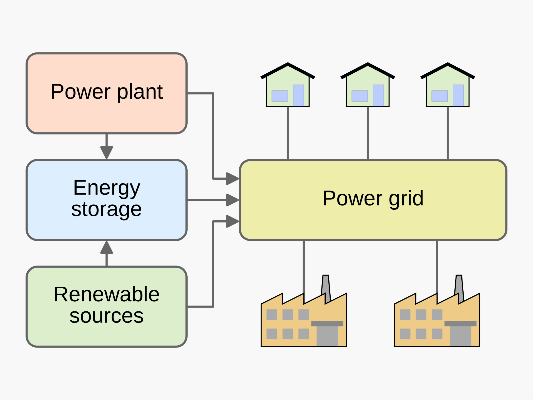
Historically, students were taught “Electricity cannot be stored on a large scale”. However, technologies are available today to convert the electrical energy into other energy forms, and to restore it on demand.
Pumped (hydro) storage was for a long time the only viable technology option, and is currently at around 200GW, 9000GWh worldwide. Battery storage (BESS) is globally at around 250GW, 600GWh. The BESS segment is dominated by lithium-ion. There are several other forms of storage which are commercially available, and are already operational at scale. These utilise technologies like compressed air, liquified CO2, flywheel, supercapacitors, gravity storage and so on.
Naturally, these technologies differ in terms of cost and project execution time. What makes it interesting is their differentiation in terms of a bouquet of technical parameters. Think of round-trip efficiency, auxiliary power consumption, response time, cycle life, storage duration, standing loss, overload capability, and grid inertia. For example, while pumped storage has a modest round-trip efficiency of 70-80% compared to 85-90% for BESS, it can deliver the stored energy for much longer periods (8 hours to even days) compared to the 2-6 hours typically delivered by a BESS. Some, like the flywheel, operate only for a few seconds at a time, while others like underground Hydrogen storage can act as strategic reserves of energy for months on end.
By RCraig09 – Own work, CC BY-SA 4.0
The BESS finds particular application in peak shifting or energy arbitrage, typically releasing the stored energy in a few hours. C&I too will find attractive behind-the-meter solutions which can reduce their MD (maximum demand) bill, or which can replace DG sets.
Transmission and Distribution system operators find benefits in using the BESS to defer capital expenditure, and also for a wide array of ancillary services like frequency & voltage support, black start, grid strengthening, and virtual inertia.
The Indian context
The Central Electricity Authority in its report on “Optimal Generation Mix 2030” has estimated that the required energy storage capacity by 2029-30 is 60.63 GW with 18.98 GW from Pumped Storage Projects (PSP) and 41.65 GW from Battery Energy Storage Systems (BESS).
Some notable steps taken by the Central government to develop the energy storage capacity in the country are:
- Notified Guidelines for Procurement and Utilization of BESS as part of Generation, Transmission and Distribution assets, along with Ancillary Services
- Issued National Framework to promote Energy Storage Systems in the country
- Issued Guidelines to promote PSP
- Granted waiver of Inter-State Transmission System (ISTS) charges for BESS and PSP
- with certain conditions
- Approved two Viability Gap Funding (VGF) Schemes for the development of large-scale BESS
As a result, several large BESS and PSP capacities have already been tendered and awarded on Build-own-operate (BOO) basis. A number of tender constructs have been used, including Stand-alone BESS, BESS with solar, and Firm Dispatchable RE (Round-the clock, Peak power, and Demand-following). These further vary in terms of the hours of storage, the PPA period and the number of cycles used per day. Over 30GW of cumulative Stand-alone BESS capacity was tendered up to end of FY 2024-25. Commercial and Industrial (C&I) customers too find the BESS to be a winning proposition.
This plethora of tenders, coupled with the falling price of Lithium-ion battery and the apparent simplicity of the plant sizing and design has led to the curious phenomenon of first-time bidders winning large tenders, with experienced RE developers remaining stranded at higher bid prices.
1 Putting together a BESS bid
The steps in making a bid can be deceptively simple.
- Take a techno-commercial offer from a Battery manufacturer (OEM), and PCS (inverter) manufacturer, and get the BESS sized by a consultant as per the Tender conditions
- Consider the BoP (Balance of plant) requirements like Inverter-duty transformer, 33kV switchgear, EHV switchyard and EHV transmission line, all of which are identical to those for a Solar or Wind plant
- Factor-in the land (BESS requires very less land, compared to solar or wind) in proximity to a grid substation
- Run the economics through a simple techno-commercial model. Calculate the IRR, LCOS (levelised cost of storage) and the corresponding bid price
Some key checkpoints are often missed by new entrants to the field, as highlighted in the following section.
2 Pitfalls in BESS bidding, execution and operation
Not all Battery OEMs are equal. Some are much more experienced than recent entrants. The cell technology too, is still evolving rapidly. The latest cells are brought to the market, after passing just the basic tests. Crucially, such cells have not been tested for an adequate number of cycles (capacity retention test). Without this backing, the OEM’s performance warranty (capacity degradation, and round-trip efficiency) over the lifetime of 12-20 years lacks credibility. Such cells have little or no actual operational experience, which could have helped the buyer to make a more informed decision.
The overall battery solution (containers) offered by the OEMs also differ in terms of the level of cell monitoring, safety designs, resilience to multiple failures, effectiveness of the cooling system in maintaining the cell temperature, and the robustness of the Battery Management System (BMS) design.
The performance of a battery is not a simple mathematical calculation. It is influenced by the environment (ambient temperature), charge and discharge rates, cell temperature, variation in cell temperature across the battery, variation in State-of-charge (SoC) between cells across the battery, duration of the period when the battery is holding full charge in a day, and duration of zero-charge period. The battery requires periodic interventions like SoC calibration and cell balancing, during which time the availability and Round-trip efficiency are impacted. Among other things, the degree of cell sorting (i.e., how identical are the cells in a container) plays a key role in some of the factors mentioned above.
While the OEM guarantees a year-on-year degradation table (State-of-health, SoH), it is subject to all the operating conditions being within the OEM specified limits.
Unless the above factors are considered in the design, the assumptions of capacity (SoH), Round-trip efficiency and availability can be way off the mark, resulting in large errors in the IRR.
The auxiliary consumption varies as per the operating condition, and requires a lot of attention. The same can be said for the plant losses, some of which can drain energy even when the plant is not operational. These aspects too, are often skipped by consultants.
3 Battery Safety
Batteries have several failure modes. The severest is the thermal runaway, as it can result into a burnout of the entire container. LFP (Lithium Iron Phosphate) is the technology of choice at the moment, for grid storage. While thermal runaway is less likely in LFP, compared to others like NMC and NCO, it cannot be ruled out. A good design of the cell and pack / module can often prevent a thermal runaway event from setting fire to the container.
The triggers to thermal runaway can be broadly grouped into Electrical, Mechanical (including thermal) and Intrinsic defects. Electrical causes are mostly eliminated by an alert BMS before actual failure occurs. Yet, several levels of redundancy are warranted. For example, if the BMS fails, then what? Some Mechanical failures can be prevented through a rigorous design of the plant (for example, crash barriers between a container and the road), while others will result into thermal runaway. A very rigorous control of quality at the manufacturing stage can weed out most Intrinsic defects.
A Standard test UL9540A checks for the failure characteristics, and for propensity to spread the failure at the cell, pack, rack and container levels. A Large-Scale Fire Test (LSFT) checks to see if the barriers and clearances are adequate to prevent the spread of fire from one container to another.
There are several other failure modes, for example deep-discharge which can permanently damage the cell. Again, it is the 3-4 layers of BMS which can detect incipient faults. As batteries age and degrade in capacity, these failure modes will become accentuated. ‘End-of-life’ (EoL) is declared by the manufacturer typically when the capacity is down to between 65 and 70%. At EoL, the battery does not stop working, rather, the risk of failure is elevated in the manufacturer’s perception.
Anyone buying batteries without looking into the specifics of the design (Cell, Module, BMS, Cooling system, and Fire detection & suppression system), the Standards complied with, the Safety tests passed, the Quality systems at the manufacturing stage, and the overall experience of the manufacturer is buying blind.
The safety standards too are rapidly evolving, with revisions coming almost every other year from NFPA, UL and IFC. Due to the above cited reasons, it is important for an IPP to ensure compliance with the latest codes, irrespective of whether they are mandated by CEA or by the Tender conditions!
Conclusion
The above remarks apply in equal measure even to a smaller BESS, for example those in the 1MW/1MWh range put up by C&I.
Putting together a BESS bid is not just about calculating MW and MWh capacities and pricing them. True success will be measured not at the bid winning stage, but when the BESS is operating safely and performing as per design!